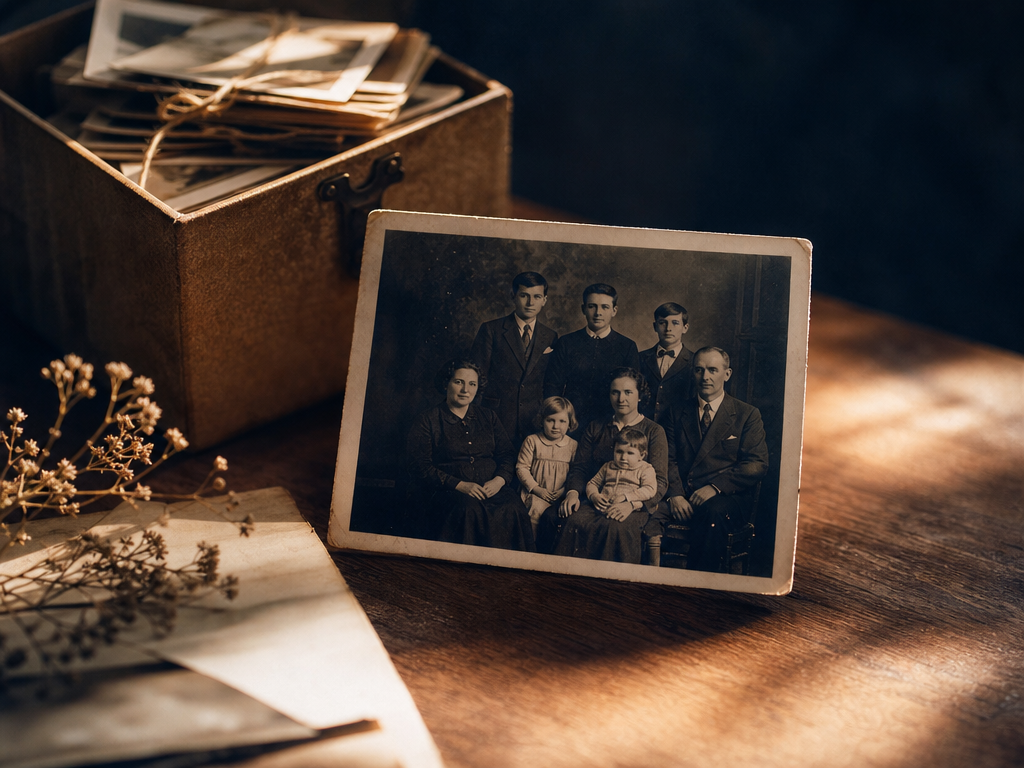
- Trauma can be passed down even without direct experience — through epigenetic mechanisms and relational patterns.
- Children of traumatized parents tend to reproduce attachment styles, hypervigilance, and regulation patterns.
- Recognizing the pattern is the first step to breaking it.
- Individual therapy can be the key to changing the family cycle.
- Breaking the cycle is also an act of care for the next generations.
You don't remember living through that scene. But your body reacts as if it were yours. You can't explain it, but you repeat a pattern you always said you never would. You compulsively care for others, or withdraw from them, or choose partners who resemble someone from your childhood — without ever consciously deciding to do so.
These experiences are not your fault. They are inheritances. And although you didn't choose to receive them, you can choose what you do with them.
What "generational trauma" means
For decades, it was believed that trauma was something a person lived through — and therefore belonged to their personal history. But research from recent decades has shown that trauma can be passed down, even without direct experience. There are two main mechanisms:
- Psychological transmission: relational patterns, attachment styles, and emotional regulation strategies learned in childhood and perpetuated in adult relationships. Children learn to relate, regulate emotions, and resolve conflicts by imitating — consciously or unconsciously — their caregivers.
- Epigenetic transmission: chemical modifications to DNA (such as methylation) that change gene expression without altering the sequence. Research with children of Holocaust survivors (Rachel Yehuda and colleagues, 2016) showed specific epigenetic marks on the FKBP5 gene — related to stress response — in people who did not experience the trauma directly.
These two mechanisms overlap and reinforce each other. The result is that, even in families where "nothing that serious happened" (at least on the surface), there are emotional marks that cross generations — invisible, yet deeply felt.
Patterns that repeat: attachment and regulation
One of the fields where generational transmission is most studied is that of attachment styles. John Bowlby and, later, Mary Ainsworth showed that children develop internal working models of relationships based on the kind of care they receive:
- Secure attachment: consistent, present caregiver, capable of holding space. The child learns they can trust, ask, make mistakes, return.
- Anxious attachment: present but unpredictable caregiver. The child learns to hyper-vigilantly monitor, to anchor themselves in the other, to fear abandonment.
- Avoidant attachment: distant or emotionally unavailable caregiver. The child learns to fend for themselves, to not need.
- Disorganized attachment: caregiver who is sometimes a source of safety, sometimes a source of fear. The child is left without a coherent model, which can generate dissociative states.
These styles tend to repeat in adult life — in partner choice, parenting style, professional relationships. But they are not set in stone. Awareness of them is the first step toward choosing differently.
What Bowen taught us
Murray Bowen, one of the pioneers of family therapy, proposed the concept of differentiation: the ability to remain emotionally connected to your family without losing yourself in it. Well-differentiated people can maintain their center, their beliefs, and their sense of self, even when the family pressures them to conform. Poorly differentiated people end up absorbing anxieties, expectations, and patterns from the family system — repeating what they saw, without realizing it.
Therapy, for Bowen, is the space where this differentiation is built. Not against the family — but from a more solid internal position. When you differentiate, the system around you inevitably begins to change as well.
Epigenetics: the body as an archive
Epigenetics has delivered, in the last twenty years, one of the most important discoveries in biomedicine: the emotional environment of our parents and grandparents may have marked our genes in ways that affect how we respond to stress, anxiety, and pain.
Studies with descendants of people who endured severe famines, wars, and persecution have found consistent patterns: greater vulnerability to anxiety, depression, and metabolic syndrome. Not because the genes "mutated" — but because their expression was modified by chemical signals that crossed generations.
This discovery is revolutionary and, at the same time, controversial. There is still much to understand about how these marks are transmitted and to what extent they are malleable. But one thing is clear: you are not just the sum of your genes, nor merely the sum of your experiences. You are the interaction between both, mediated by what came before you.
How to break the cycle
The good news — and there is good news — is that generational patterns can be broken. It is not easy, it is not quick, and it is almost never work you do alone. But it is possible. Here are some ways:
Recognize the pattern
The first step is to see. Without judgment, without guilt, without rational "cover." Acknowledge: "I am repeating something I saw before me." It may be in the way you argue with your partner, the way you treat your children, the way you react to mistakes, the way you care for yourself. Looking at this honestly is already a form of interruption.
Seek therapy
Individual therapy is often the most effective space for breaking generational patterns. In regular sessions with a professional who understands this topic, it is possible to identify where certain reactions come from, process inherited traumas (even without direct experience), and build new ways of relating.
Approaches such as EMDR, Brainspotting, and somatic therapy are especially useful because they access layers where patterns are inscribed — in the body, in the subcortex, in neural networks formed even before conscious memory.
Build internal resources
The more internal resources you have — emotional regulation, self-knowledge, secure bonds, the ability to ask for help — the less vulnerable you are to inherited patterns. These resources can be developed in adulthood, even if they were missing in childhood.
Create new experiences
Every time you respond differently to a situation where the old pattern would have demanded the habitual reaction, you are creating a new imprint on your nervous system. Over time, these new experiences accumulate and reconfigure what once seemed inevitable.
Acknowledge what came before you
Much of generational work involves looking at your parents, grandparents, ancestors — not to blame them, but to understand. They too were marked. They too passed on what they could, with the resources they had. Acknowledging this helps release the anger that often keeps the pattern in motion.
What you inherited is not your destiny. It is your starting point. The path from there is yours.
A gift for the next generations
When you break a pattern, you are not doing it only for yourself. You are, at the same time, changing what will be inherited by the next generations. Children who grow up seeing a parent who managed to address their traumas differently, who learned to regulate emotions without violence, who built healthier relationships — they inherit that. Not just through epigenetics — through lived experience, through example, through affection.
Breaking generational patterns is, therefore, also an act of care for those who will come after you. Even if you never meet them.
Start where you are
You don't need to understand everything about your family tree to begin. You don't need to talk to your parents or grandparents about what they lived through. You can start with what you notice in yourself: the patterns that repeat, the reactions that feel automatic, the fears that have no clear story.
Acknowledging where you are, today, in the present, with compassion — that is the starting point. The rest will reveal itself, at your pace, in your own time.
Did something here resonate?
If some of these words described what you feel, perhaps it's time to talk. The first step can be an initial conversation, with no obligation.

About the author
Trauma specialist, with training in EMDR through TraumaClinic / EMDR Brasil and in Brainspotting through the Dr. David Grand method. Online sessions for Brazil, Brazilians abroad, and English-speaking foreigners.
Childhood trauma and mental health
How childhood traumas echo into adult life and relationships.
Avoidant attachment vs anxious attachment
Attachment styles formed in childhood and how they show up.
- [1] Yehuda, R., et al. (2016). Holocaust Exposure Induced Intergenerational Effects on FKBP5 Methylation. Biological Psychiatry.
- [2] Bowers, M., & Yehuda, R. (2016). Intergenerational Transmission of Stress in Humans. Neuropsychopharmacology.
- [3] Bowen, M. (1978). Family Therapy in Clinical Practice. New York: Jason Aronson.
- [4] Van der Kolk, B. (2014). The Body Keeps the Score. New York: Viking.
- [5] Herman, J. (1992). Trauma and Recovery. New York: Basic Books.
- [6] Wolynn, M. (2016). It Didn't Start with You [It Didn't Start with You]. New York: Viking. Portuguese edition published by Editora Alaude (2017).
The references listed are foundational works in trauma and nervous system regulation. This article is informational and does not replace an individualized clinical assessment.

We can talk about what you are going through, with no commitment.

Living in alert mode: what anxiety is trying to tell you
Persistent anxiety is a body signal. Understand the state of hypervigilance.
Read article →
How the brain reprocesses difficult memories
What happens in practice during an EMDR session.
Read article →
After an abusive relationship: rebuilding yourself
Paths to rebuild trust in yourself, at your own pace.
Read article →